
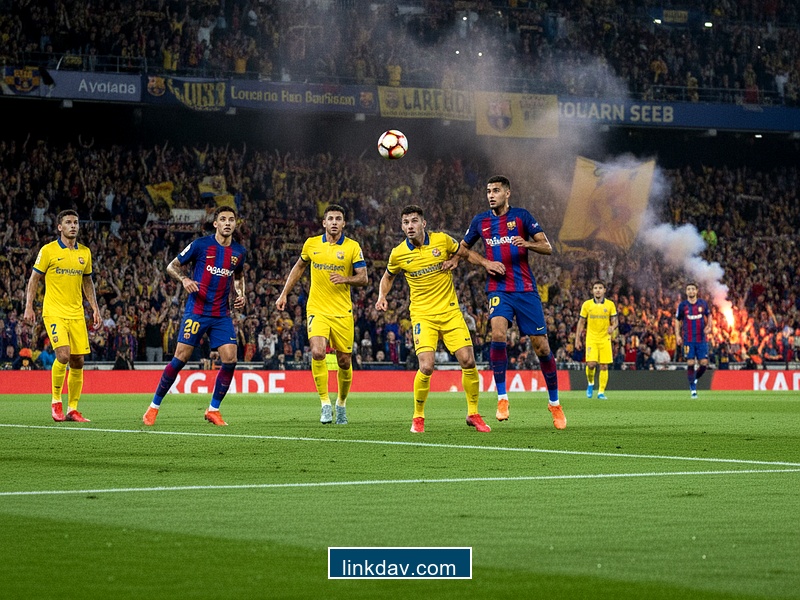
If you only read the scoreboard, you would think Barcelona took a leisurely stroll through Castellón. A 5-1 away victory usually implies dominance, comfort, and a cigar lit in the 80th minute. But anyone sitting in the scouts' row at the Estadio de la Cerámica knows the scoreboard is a liar. This wasn’t a dismantling; it was a high-wire act performed without a net.
Villarreal didn't lose because of a lack of effort. Marcelino García Toral had his men playing with the frantic energy of a team possessed. They lost because Hansi Flick has introduced a level of defensive arrogance that La Liga hasn't seen since the peak of Arrigo Sacchi’s AC Milan. It is a system built on "suicide lines" and millimetric precision, where the difference between a goal conceded and an offside flag is the twitch of a center-back’s hip muscle.
The Art of the High Line: A Scout’s View
To understand why Villarreal collapsed, you have to ignore the ball. Watch Iñigo Martínez and Pau Cubarsí. Throughout the match, their average positioning was effectively on the halfway line, compressing the pitch into a 40-meter box. In professional scouting terms, we call this "suffocating the vertical space."
Villarreal put the ball in the net three times that didn't count. The casual observer calls this bad luck. I call it structural design. When Yeremy Pino or Nicolas Pépé made their runs, they weren't failing; they were being manipulated.
Watch the body language of the Barcelona backline. There is no panic. When the ball is played over the top, most defenders instinctively drop their center of gravity and turn to sprint toward their own goal. Martínez and Cubarsí do the opposite. They hold their ground, keeping their hips square to the play until the exact moment of contact. This delay forces the Villarreal attackers to check their runs or drift offside. It is a psychological game as much as a tactical one.
"The modern offside trap isn't about raising your hand; it's about freezing your feet. It requires a level of trust between center-backs that usually takes seasons to build. Flick has instilled it in months."
Scanning and the "Third Man" Run
While the defense played Russian Roulette, the offense dissected Villarreal through what we call "scanning frequency" and "blind-side movement." This is where Raphinha has transformed from a chaotic winger into a world-class raumdeuter (space interpreter).
Look at the build-up to the fourth goal. Before the ball even reached the final third, Raphinha had scanned over his shoulder four times in six seconds. He wasn't looking for the ball; he was mapping the hips of Raul Albiol and Eric Bailly. He identified that Bailly was over-committed to Lewandowski’s physical pinning, leaving the half-space exposed.
This is the "unseen work." Raphinha’s runs are rarely straight. He arcs his movement to stay in the defender's peripheral vision—the "blind side"—until it’s too late. Villarreal’s midfielders, Parejo and Comesaña, are technically gifted but lacked the defensive transition speed to track these runners. They were constantly reacting to the pass, rather than anticipating the movement.
Lamine Yamal: The Pausa in Chaos
Physicality is easy to spot. Intelligence is harder. Lamine Yamal’s assist for the fifth goal was a masterclass in "La Pausa"—the ability to stop time. In a game played at 100mph, Yamal received the ball and simply stopped.
From a biomechanical standpoint, watch his deceleration. He drops his hips, feints a drive inside, and freezes the defender. The Villarreal left-back, Costa, had his weight on his heels, terrified of the dribble. That hesitation opened the passing lane. The trivela pass (outside of the boot) wasn't showboating; it was the only geometric solution to bypass the defensive block without shifting his own body orientation, which would have telegraphed the pass.
The Marcelino Paradox
We must credit Marcelino. His 4-4-2 block is historically one of the hardest to break down in European football. He demands immense physical output. Villarreal’s pressing triggers were correct. They engaged Barcelona high, forcing turnovers and creating chaos. In terms of Expected Goals (xG), the game was much closer than 1-5 suggests.
However, Marcelino’s system failed in "rest defense." When Villarreal attacked, their full-backs committed high, leaving a 2v2 situation at the back against Lewandowski and Raphinha. In the modern game, if you cannot sustain a 3v2 advantage defensively while attacking (usually by tucking a fullback inside or holding a pivot), you are inviting death against a vertical transition team like Flick’s Barca.
Xavi’s Barcelona wanted control through possession. Flick’s Barcelona wants control through territory and verticality. They don't mind if the game becomes a basketball match because they trust their athletes to win the transition duels. Villarreal tried to match that athleticism but lacked the structural discipline in the defensive transition.
The Ter Stegen Shadow
We cannot ignore the injury to Marc-André ter Stegen. From a scouting perspective, the reaction of the team was telling. Often, when a captain and goalkeeper goes down screaming, the defensive line drops deep out of fear. They lose their security blanket.
Barcelona did the opposite. They stayed high. Iñaki Peña stepped in, but the leadership void was filled by the collective aggression of the outfield players. This speaks to a coaching methodology that values the system over the individual. The "machine" continued to function because the instructions—press high, hold the line, run into space—are absolute, regardless of who wears the gloves.
Conclusion: The Trap is Set
Villarreal tried everything. They pressed, they countered, they scored (illegally), and they fought. But they were dismantled by a Barcelona side that has weaponized geometry. Flick has turned the offside line into an offensive weapon, compressing the field so aggressively that opponents suffocate.
The 1-5 scoreline suggests a battering. The tape shows something scarier: a tactical blueprint that lures teams into thinking they have a chance, only to snap the trap shut the moment they commit. Villarreal didn't just lose a football match; they lost a game of chess played at sprinting speed.