
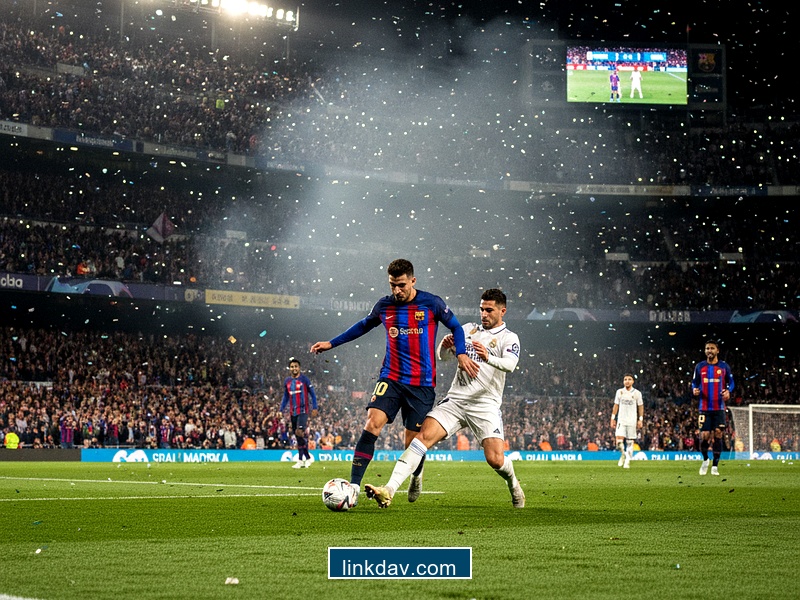
If you paused a Barcelona match in mid-October this season and looked at the average positioning of their defensive line, you would assume the freeze-frame was a glitch. Or perhaps a mistake by the broadcaster. Defensive lines do not sit 50 meters from their own goal against Real Madrid or Bayern Munich. It is a tactical heresy. It invites disaster. It is, by all conventional wisdom, suicide.
Yet, here we are at the midseason turn. Hansi Flick hasn’t just steadied the ship following the emotional and somewhat chaotic exit of Xavi Hernandez; he has turned it into a high-speed destroyer. The verdicts are in, and while the points table tells us Barcelona leads the way, the underlying numbers tell a much more fascinating story about the "Project." This isn't a team winning on individual brilliance alone, though Lamine Yamal is generational. This is a team winning because of a radical, terrifying, and sophisticated philosophical shift.
To understand whether this is sustainable, we must look past the 90-minute scoreboards and dissect the mechanics of Flick's machine. We are witnessing the most aggressive implementation of the high defensive line since Arrigo Sacchi’s AC Milan in the late 1980s, and it forces us to ask: Is this genius, or is the crash inevitable?
The Rejection of Control for Chaos
For nearly two decades, the "Barcelona Way" has been synonymous with control. From Pep Guardiola through to Xavi, the objective was Juego de Posición—positional play designed to monopolize the ball, suffocate the opponent in their own half, and minimize risk through possession. If you have the ball, they can't score.
Flick has taken that script and incinerated it. The German coach does not seek control in the traditional Catalan sense; he seeks verticality. His Barcelona is happy to lose the ball if it means they can win it back instantly in a dangerous area. This is the difference between a conductor and a demolition expert.
The current Barcelona side averages fewer passes per sequence than Xavi’s iteration but generates a significantly higher xG (Expected Goals) per 90 minutes. They have traded safety for lethality.
This shift requires a specific type of athlete. Under Xavi, the midfielders were chess pieces moving into zones. Under Flick, Marc Casadó and Pedri are engine pistons. The philosophy is distinctly Germanic—Gegenpressing imported to the Mediterranean coast—but it relies on a daring defensive structure that makes the whole system possible. If the press fails, the defense must be high to compress the space. If the defense drops, the press is easily bypassed. It is an all-or-nothing ecosystem.
The Offside Trap as a Primary Weapon
Most defenses use the offside trap as a contingency. For Flick’s Barcelona, it is a primary offensive weapon. By condensing the pitch, they force the opponent to make split-second decisions under immense pressure. The stats are staggering: Barcelona has caught opponents offside more than any other team in Europe's top five leagues by a wide margin. In El Clásico, Kylian Mbappé—arguably the fastest forward on the planet—spent the evening living in an offside flag nightmare.
This strategy relies on the astonishing tactical discipline of Pau Cubarsí and Iñigo Martínez. Cubarsí, barely old enough to drive, is coordinating a defensive line that operates on razor-thin margins. This is where the sustainability question arises. This system requires mental exhaustion as much as physical exertion. One lapse in concentration, one defender dropping a fraction of a second too late, and the clean sheet evaporates.
Comparative Tactical Philosophy
| Metric | Xavi's Philosophy (2023) | Flick's Philosophy (2025) |
|---|---|---|
| Defensive Line | High, but drops on transition | Extremely High (Suicide Line) |
| Possession Intent | Control and circulate | Vertical penetration |
| Player Profile | Technical specialists | Physical hybrids (Endurance + Tech) |
| Risk Tolerance | Low | Extreme |
Historically, teams that play this high eventually get found out. Opponents stop trying to play through the midfield and start hitting long, diagonal balls into the channels to bypass the press entirely. We saw flickering signs of this vulnerability against Real Sociedad earlier in the campaign. The question isn't if teams will try this, but if Barca's pressing intensity can remain high enough to prevent the passer from lifting their head in the first place.
La Masia: Necessity or Strategy?
One cannot analyze the current Barcelona project without addressing the financial elephant in the room. Barcelona is broke. They cannot sign Galacticos. Real Madrid signed Mbappé; Barcelona promoted kids. However, Flick’s management of these youngsters differs fundamentally from his predecessors.
Ronald Koeman played the youth out of desperation. Xavi played them out of romanticism. Flick plays them because they are the only ones malleable enough to execute his physical demands. Veterans often resist the cardio-heavy demands of a Flick system (look at the friction at Bayern Munich towards the end). Teenagers like Lamine Yamal, Fermín López, and Alejandro Balde do not know any better. They run until they drop because the system demands it.
This creates a vertical integration that is the envy of Europe. While Real Madrid buys ready-made stars, creating a sometimes disjointed collection of egos, Barcelona is forging a collective identity in the fire of necessity. But this comes with a grim warning label. We have seen the likes of Pedri and Gavi breakdown under immense workloads before. Flick’s system is physically redlining young engines. The short-term gain is a title charge; the long-term risk is burnout before the players hit twenty-one.
The Madrid Variable: Why the Race isn't Over
Despite Barcelona’s aesthetic dominance and points lead, the title race remains dangerously alive. This is due to the nature of their rival. Real Madrid, under Carlo Ancelotti, represents the antithesis of Flick’s structural rigidity. Madrid is fluid, chaotic in a different way, and reliant on moments of individual transcendence.
History teaches us that systems eventually stutter. When the legs get heavy in March and April, the high line will drop a few meters. The press will lose a step. When the system fails, you need individuals to bail you out. Barcelona has Lewandowski and Yamal, but Madrid has a bench worth half a billion euros.
The "Project" at Madrid is to be inevitable. The "Project" at Barcelona is to be perfect. Perfection is much harder to sustain over 38 games than inevitability.
Verdict: A Glorious Tightrope Walk
Is this sustainable? If we define sustainability as maintaining this exact level of intensity for five years, then no. Jurgen Klopp’s "heavy metal" football at Liverpool eventually required a reboot, and Flick’s own Bayern burned bright and fast before defensive cracks appeared. The physical toll is simply too high.
However, for this season, it is the shock therapy Barcelona desperately needed. The club had become lethargic, trapped in the shadow of the Messi era and the financial levers. Flick has provided clarity. There is no ambiguity in his football. You press, you push up, you run.
The midseason verdict is clear: Barcelona is the best team in Spain not just because of points, but because they have a distinct, unified identity. Real Madrid is still searching for the best way to fit their superstars together. Flick has built a machine that is greater than the sum of its parts. It might crash in the spring—high-wire acts often do—but right now, it is the most compelling tactical experiment in European football.