
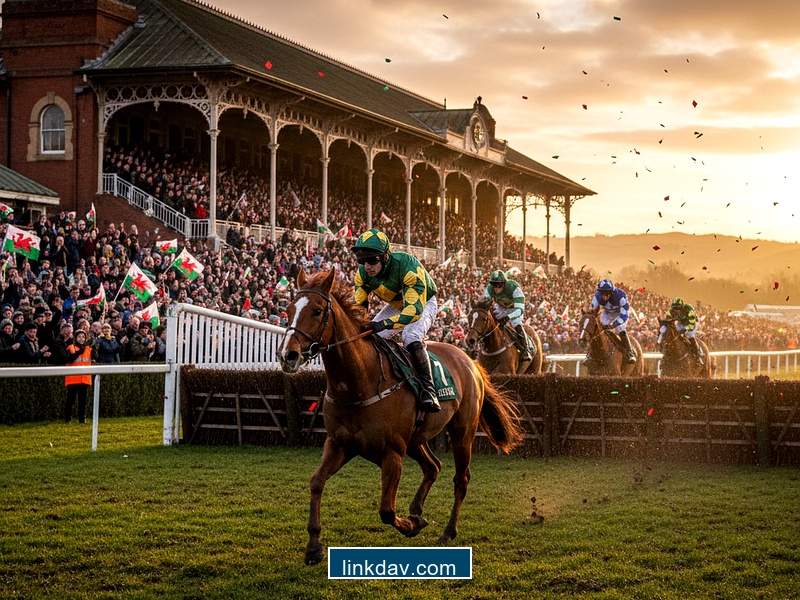
There is a specific kind of madness required to look at the topography of Chepstow Racecourse—a undulating, stamina-sapping cauldron that feels less like a sporting venue and more like a medieval siege engine—and decide that this is where you will stake your professional reputation. In modern football, we fetishize the high press and the sterile domination of possession. In National Hunt racing, the equivalent is the sleek, speed-orientated dominance of the Irish super-yards. But the Welsh Grand National represents the antithesis of the modern sporting product. It is archaic, brutal, and, this year, unusually dry. For Sam Thomas, the man holding the keys to the favourite, this isn't just a race; it is a stress test of his entire managerial philosophy.
The Thomas Project: Reconstruction over Revolution
To understand the pressure on Sam Thomas, one must look beyond the betting slip. Thomas is not merely a trainer; he is the architect of a specific competitive identity. Having ridden Kauto Star and Denman—the Messi and Ronaldo of the chasing world—Thomas understands elite performance. However, his transition to the "dugout" (the training yard) has been defined by a localized pragmatism that rivals the shrewdest Championship managers.
His handling of the market leaders in a race he won in 2021 with Iwilldoit reveals a distinct methodology: the prioritization of the specialist over the generalist. In an era where the Willie Mullins empire (the Manchester City of the sport) hoards talent to dominate every division, Thomas operates a boutique recruitment strategy. He targets horses with the specific biomechanics to handle deep mud and three-and-three-quarter miles. This is Moneyball with haynets.
"I wouldn't swap him for anyone."
This quote regarding his big-race hope is not merely defiant bluster; it is a defense of his scouting system. The modern racing economy pushes trainers to run horses often to satisfy syndicates. Thomas, conversely, has adopted an Arsène Wenger-esque patience. He campaigns his horses lightly, preserving their "engine" for specific tactical windows. The fact that the ground at Chepstow has remained stubbornly dry is the climatic equivalent of a possession-based team arriving at the pitch to find the grass left deliberately long. It disrupts the tactical blueprint.
The Anomaly of the "Dry" Welsh National
We need to address the elephant in the room, or rather, the lack of bog. The Welsh National is historically the ultimate endurance test, often run in conditions resembling the Battle of the Somme. The average winning time can drift towards nine minutes. When the ground is "good to soft" rather than "heavy," the tactical profile of the race shifts violently.
On heavy ground, the race is won by the horse with the highest anaerobic threshold—the grinder. On drier ground, the race becomes a rhythm event, favoring horses with higher cruising speeds and quicker recovery rates over fences. This threatens to neutralize the "Old School" assets. It forces a manager like Thomas to question if his squad is built for the wrong war. The sustainability of his yard's success relies on exploiting the niche of extreme stamina. If climate shifts or drainage improvements turn Chepstow into a speed track, the "Thomas Project" loses its distinctive market advantage.
Mr Vango and the Bradstock Romanticism
While Thomas represents the modern, tactical professional, the presence of Mr Vango introduces a clash of philosophies. Described as "enchantingly old-school," Mr Vango represents the Mark and Sara Bradstock approach. If Thomas is the pragmatic tactician, the Bradstocks are the eccentrics—the Marcelo Bielsas of the Cotswolds. Their operation is famous for hill work, small numbers, and an almost spiritual belief in the staying chaser.
Mr Vango’s performance is not just about 90 minutes (or 8 minutes) of sport; it is a referendum on whether the "giant horse" phenotype still works in 2025. Modern fences are softer; races are faster. The lumbering, monolithic galloper is becoming an evolutionary dead end. A win for Mr Vango would be a victory for heritage over aerodynamics. It validates the idea that you can still win big by simply outlasting the opposition rather than outrunning them.
The Sustainability of the "Chepstow Specialist"
The deeper question for any stable targeting this race is the cost of victory. In football, a manager rotates the squad to avoid burnout. In racing, the Welsh National often leaves a mark that takes a year to heal. Historical data shows that winners of this race frequently endure a massive dip in form subsequently—the dreaded "Chepstow Hangover."
| Winner | Subsequent Season Form | The "Project" Impact |
|---|---|---|
| Native River (2016) | Gold Cup Glory | The outlier. Proved elite class transcends the grueling test. |
| Potters Corner (2019) | Winless for years | The classic burnout. Peak achieved, but the engine was spent. |
| Mountainous (2013/15) | Inconsistent | A specialist who could only function under specific "mud" parameters. |
For Rebecca Curtis, fielding Haiti Couleurs, the calculation is brutal. Do you spend your horse's career capital on this one afternoon? Curtis, who has rebuilt her yard after fluctuating fortunes, knows that a Welsh National flag in the ground attracts owners. It is a loss-leader strategy: break the horse to build the brand. It is a cynical view, perhaps, but this is a business where nostalgia does not pay the feed bills.
The Verdict: Management under the Microscope
Sam Thomas stands at a precipice. The unusually dry conditions have stripped away the great equalizer of mud, leaving his tactical setup exposed to faster, potentially classier rivals. If his favourite wins on quicker ground, it proves his "Project" is versatile, capable of evolving beyond the mud-lark stereotype. It would signal his transition from a promising manager to an elite one.
However, if the race goes to a speedier type, or if the "Old School" Mr Vango grinds them into submission regardless of the surface, it will suggest that the Thomas philosophy is either too rigid or not yet potent enough to dismantle the romantic anomalies of the sport.
Chepstow is rarely just a race. It is a collision of ideologies: the small yard vs. the super-stable, the speed merchant vs. the grinder, the romantic vs. the pragmatist. When the tapes go up, we aren't just watching horses jump fences; we are watching managers pray that their long-term architectural plans survive contact with the enemy.